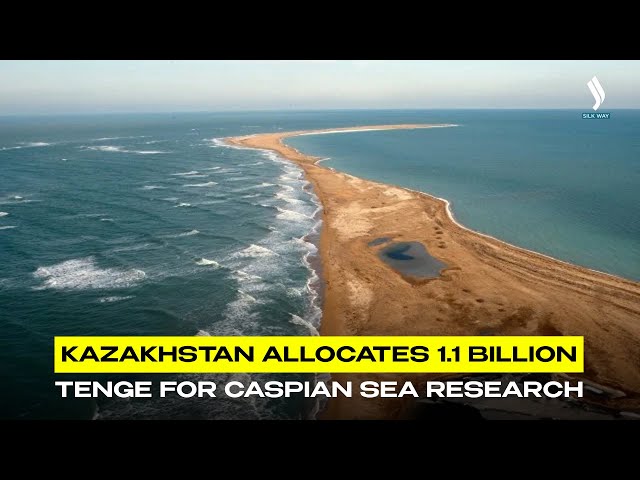
Kazakhstan has allocated more than one billion tenge
for a comprehensive study of the Caspian Sea. The funds from the state reserve
will be used to purchase marine monitoring equipment and equip hydrobiological
and hydrochemical laboratories. The Kazakh Research Institute of the Caspian
Sea has developed a program that includes two marine expeditions to 21
stations, as well as land-based studies at 22 coastal sites. These works are
scheduled to be carried out this year. Currently, the state of the sea is monitored
using 50 parameters, while another 26 are used to assess the coastal zone. At
the instruction of President Kassym-Jomart Tokayev, Kazakhstan is also
continuing to prepare a joint program for the Caspian littoral states. Its goal
is to unite the countries’ efforts to conduct research, adapt, and preserve the
Caspian ecosystem.
«A series of international events dedicated to the
environment, science, and innovation has been underway in the Mangystau region
since August 6. Throughout the week, participants have been discussing
environmental projects, taking part in hackathons and scientific sessions, and
presenting their research findings. The events have brought together
representatives of the Caspian littoral states –Azerbaijan, Russia, and Iran – as
well as Central Asian countries, including Turkmenistan, Uzbekistan, the Kyrgyz
Republic, and Tajikistan. They are joined by volunteers, environmental
activists, scientists, experts, and young people,» noted Daulet Yesmagambetov, Director of the Department of Environmental
Culture and Policy, Kazakh Ministry of Ecology and Natural Resources.
It is worth noting that over the past two and a half
years, more than 35 billion cubic meters of water have flowed into the sea via
rivers, including water from the 2024 floods. Since the beginning of this year,
6 billion cubic meters of water have flowed through the Ural and Kigach rivers.
According to scientists, the inflow is gradually increasing.
«The Northern Caspian deserves particular attention.
It is very shallow. Most of its water comes from the Volga River, but the
river’s inflow has been declining recently. Meanwhile, the Ural River
contributes relatively little water,» said Mansiya Yessenamanova, Professor, Atyrau University.

Related Articles